
- Article
How kuafu makes flexibility scalable
Solar panels and electric vehicles are booming – so that’s great for the energy transition, right? Or does it just mean new problems to solve?
Trick question! Of course, both are true. We’ve already looked at how this new landscape, with multiple, unpredictable sources of both supply and demand, makes grid stability much harder to maintain. The urgent problem now is figuring out how to align that rapidly changing supply and demand, so that user needs are met without overloading the infrastructure. Grid2050 member project kuafu is working on that.
With buildings at the hub of energy supply and demand – feeding energy in from solar panels, drawing it out through heat pumps, EVs and other devices – that’s a logical place to focus on managing demand. Until now, though, “flexibility” has meant actively choosing when to run devices: charging your car at off-peak times, for instance. Kuafu is automating that decision.
Kuafu’s orchestration layer is based on a predictive control engine that takes into account historic data (when are cars in this building typically being charged?), availability of solar power, and constraints provided by the grid operator. In other words: the utility sends parameters to the kuafu platform. The algorithm plans for expected draw-down and enforces the limit, releasing charging according to capacity, but without affecting the user experience. There’s no extra burden on the user, and no compromise; just greater efficiency.
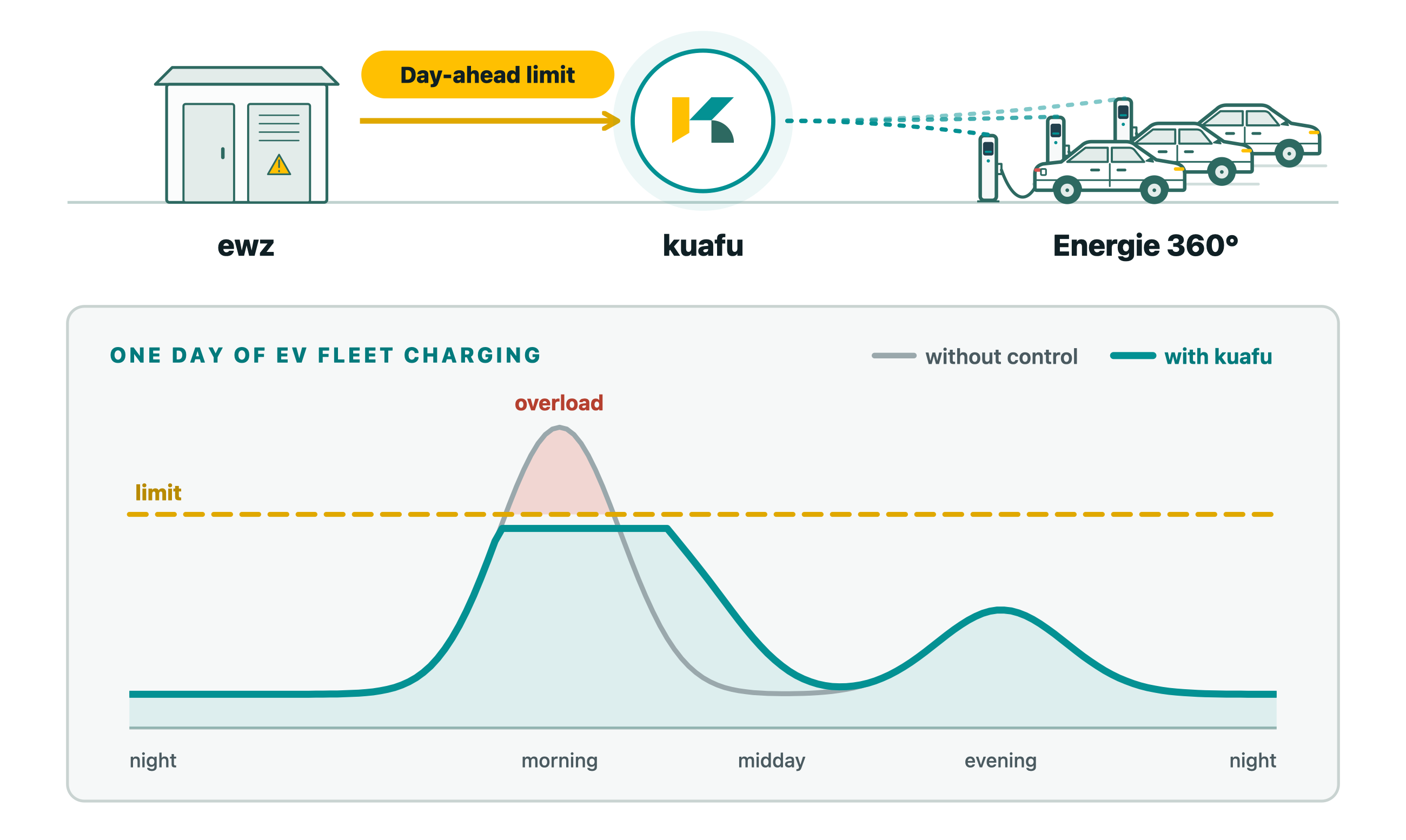
Two pilot schemes recently confirmed its effectiveness: using the platform achieved a 72% improvement in cost reduction (compared with a standard peak-shaving controller, operating with fixed parameters), and reduced grid overload by 90%. Most importantly, the primary goal was attained: optimising the charging schedule didn’t affect service. Users all got what they needed, just with less burden on the system.
This promises a real breakthrough. Energy policy asks operators to manage demand flexibility as a first step to improve capacity, before reinforcement or expansion of the infrastructure. However, without scalable, automated solutions to introduce that flexibility, this could be considered a goal rather than a practical tool.
Kuafu changes that. Its standardised interface can be implemented easily by any of the many independent suppliers on both sides of the energy market: utilities, building managers, energy management systems… It does away with the need for ad hoc, bilateral communication, and enables smooth service delivery even when the partnerships change.
While the pilot schemes did confirm expectations, they also delivered some lessons for what needs to be considered next. One unexpected factor turned out to be a limitation from the building manager: they required no interference with the charging of visitors’ cars – and there were a lot of visitors. It’s understandable that on short visits, users may need energy immediately, which rules out flexibility. The question is, how to factor that in? It’s not so much a technical question as a practical one. How far can grid constraints be traded off against user convenience? What compensation might make it worth disrupting the service?
While these questions will be important for ensuring grid stability without compromise, what is already clear is that kuafu’s predictive control engine can play a crucial role. Thanks to its forecasts, it is possible to plan and automate draw-down; thanks to the orchestration layer, demand can be optimised without time-consuming direct communication between parties. Together, this could make flexibility the practical commodity it needs to be.